When Steam Turbine Blades Need Replacement: A Practical Guide
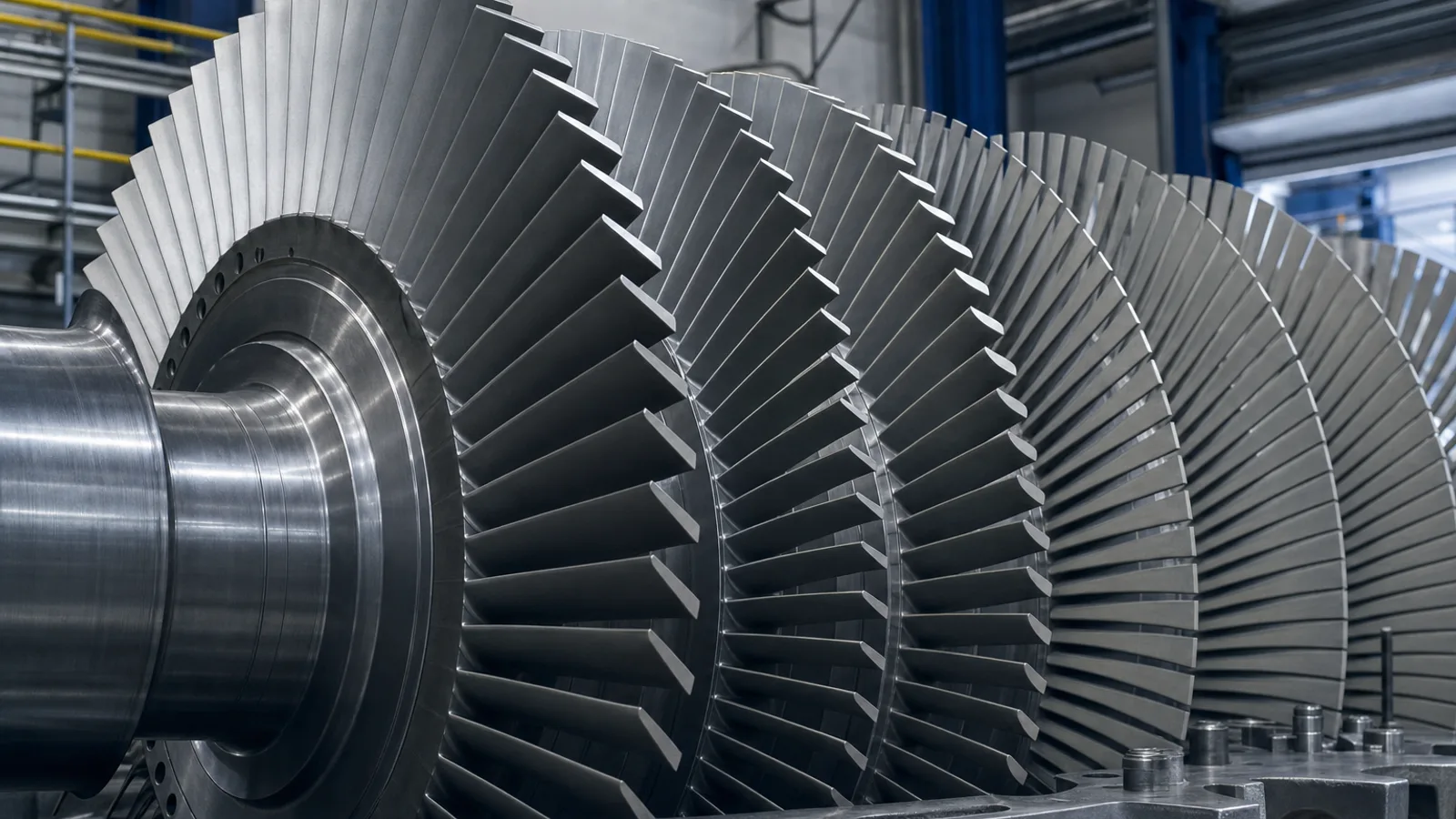
"A turbine blade is not a spare part you order from a photo. It is a precision component with profile tolerances down to hundredths of a millimetre, individual balancing, and a firm tie to a specific stage. When a request comes in saying 'blades like in the picture' — the first question is: where is the blade root drawing and which blade row is it? Without that, there is nothing to discuss."— Chief Design Engineer, repair facility, 22 years in turbine manufacturing
Turbine blade replacement is rarely planned in advance during scheduled maintenance — more often the decision is triggered by vibration diagnostics results, an abnormal rise in bearing temperatures, or visual defects found during HP/LP cylinder inspection. But between "we found a crack" and "the complete set is ready" there is a stage where most orders stall: incomplete or incorrect source data. This article walks through the steps — when replacement is unavoidable, how to choose the blade configuration, and what documentation package the manufacturer needs to start production without unnecessary back-and-forth.
Task context: why blades are a critical component
The turbine blade is the most heavily loaded element of the flow path. It is simultaneously subjected to centrifugal forces from rotation, alternating bending loads from the steam flow, thermal stresses, and an aggressive environment: wet steam in the LP cylinder causes water-droplet erosion of the leading edges, while the first stages of the HP cylinder experience solid-particle abrasive erosion from boiler scale. The blade root and shroud carry their own fatigue loads, and the phase-transition zone is subject to corrosion fatigue.
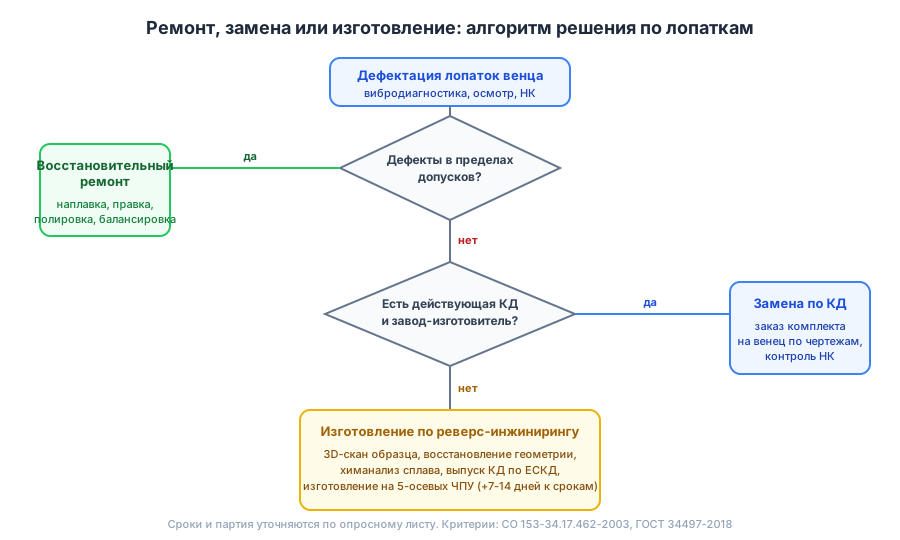
Every steam turbine blade is a precision component with individual balancing and a firm tie to a specific stage. Steam turbine rotor/working blades are replaced by three methods, and mixing them up is not an option: restoration repair (hard-facing, straightening, polishing) is used for surface defects within acceptable limits; blade replacement with new parts per the current design documentation — when wear has exceeded rejection criteria but the OEM and documentation still exist; manufacture from scratch via reverse engineering — for discontinued sizes where neither drawings nor tooling remain at the manufacturer. All three scenarios are covered in detail on the RUSTRADE turbine blade manufacturing and replacement page.
Why "buy the same one" almost never works: manufacturers change their product range, sizes are discontinued, drawings get lost during ownership changes. Even when a catalogue number is available, it turns out the item has been withdrawn or replaced by a non-equivalent version. As a result, ordering spare parts for turbines in 2025–2026 is almost always an engineering task, not a simple catalogue lookup.
Why this matters now
Since 2022, supplies of imported turbine components have been restricted. Plants that previously sourced their needs from original manufacturers are forced to switch to domestic production or reverse engineering. This raises the requirements for source data quality in the request: the manufacturer must reconstruct the geometry from a sample, select a Russian equivalent steel grade, and issue design documentation per ESKD — meaning that without a complete set of source data, no responsible manufacturer will start production.
— from RUSTRADE practice, turbine components divisionKey technical parameters and selection criteria
Profile and joint geometry
The airfoil profile is a set of control cross-sections with suction-side and pressure-side coordinates. The blade root determines the mounting method and load-bearing capacity: T-root and straddle/mushroom root — for short and medium-length blades, secured by locking blades installed last in the disc slot; fork/finger root — slid in from above, allowing a blade to be changed without removing adjacent blades; fir-tree root (axial entry) — maximum load-bearing capacity, used on long last-stage LP blades. The root type determines the milling technology and the method of fit inspection.
The shroud and lacing/damping wires shape the dynamics of the blade row: a rigid shroud creates a rigid spatial structure, while damping wires suppress vibration. Blade pitch, setting angle, and airfoil height are parameters that determine stage efficiency. Locking blades of steam turbines are a separate line item in a set: their geometry differs from standard blades, and they must be ordered as part of the blade row, not individually.
Materials and permissible temperatures
Steel grades for steam turbine blades are governed by GOST 5632-2014 and SO 153-34.17.462-2003. Main grades in use: 12Kh13-Sh, 20Kh13-Sh — blades up to ~440 °C (reference up to 500 °C); 15Kh11MF-Sh — up to 540–560 °C; 18Kh11MNFB-Sh (EP291-Sh) — up to 580 °C. The stated limits are indicative per grade tables; the exact grade and regime are confirmed against the design documentation and OEM specification. Specific grades for particular operating conditions are clarified via the questionnaire/data sheet.
Coatings and hardening: stellite inserts are brazed to the leading edges of wet-steam stages — protection against water-droplet erosion. Ion-plasma nitriding and other hardening methods are specified depending on the stage and operating conditions via the questionnaire/data sheet.
Rejection criteria
| Parameter | Impact on the request | Data source |
|---|---|---|
| Root type | Determines milling technology, need for locking blades | Design documentation, sample, measurement |
| Steel grade | Blank selection, heat treatment regime, supplier | Design documentation, chemical analysis |
| Airfoil profile | 5-axis CNC control program, inspection gauges | Drawing / 3D scan |
| Shroud, damping wires | Blade row dynamics, attachment method | Design documentation / sample |
| Stage and steam parameters | Material selection, coating, tolerances | Questionnaire/data sheet |
| Set quantity | Balancing groups, mass, lead time | Questionnaire/data sheet |
If source data is insufficient — request blade selection by sample and drawing via our questionnaire/data sheet: an engineer will get in touch and clarify the critical parameters before the calculation starts.
Common customer errors when submitting a request
1. Request based on a nameplate photo
A photo of the data plate gives the turbine type but not the blade geometry. Without measuring the airfoil profile and root, manufacture is impossible. A sample or drawing is required. Requests along the lines of "buy steam turbine blades" without source data make it impossible to calculate the job.
2. Steel grade not specified
"Stainless steel" is not a grade. Without a chemical analysis or a reference to the design documentation, the manufacturer cannot select a blank or a heat treatment regime.
3. No stage and steam parameter data
Steam pressure, temperature, and moisture content at the stage inlet determine the choice of coating and material. Without this data, only the standard configuration is possible — which may not be suitable.
4. Balancing and frequency detuning overlooked
Blades within a single blade row are split into balancing groups by mass. An order without mass tolerances means vibration after installation and an unscheduled shutdown.
5. Ordering individual blades instead of a full blade-row set
Replacing one or two blades upsets the balance of the blade row. GOST 34497-2018 governs the replacement procedure; as a rule, a complete blade row or at least half of it is replaced, with rotor re-balancing.
6. No root and disc data
The fit tolerances of the blade root in the disc slot are a critical parameter. Without the slot coordinates, the fit cannot be verified by calculation — only by physical trial-fitting during installation, which is expensive and time-consuming.
Practical application scenarios
Scenario 1: direct reproduction from design documentation
When the design documentation is preserved and the OEM is accessible — this is the shortest path. The drawing with tolerances, the material grade per GOST 5632-2014 and OST 108.020.03-82, and the heat treatment and NDT requirements are transferred. The manufacturer goes straight to tooling and CNC control programs for 5-axis machining of the airfoil curved surfaces. Lead time is minimal; quality is reproducible.
Scenario 2: reverse engineering of a discontinued blade
The OEM has closed, no drawings remain — only a worn sample or a few blades from a previously used set. The process: 3D scanning with wear compensation, reconstruction of nominal geometry based on design conventions, chemical analysis of the alloy to select a Russian equivalent per GOST 5632-2014, and issue of design documentation per ESKD. The manufacturing lead time is extended by 7–14 days for reverse engineering and drawing approval. A detailed procedure for developing project and working documentation is available on the PD and WD design page.
Scenario 3: blading upgrade during overhaul
A plant uses the overhaul as an opportunity to improve stage performance: switching to a more heat-resistant material, adding stellite inserts to the leading edges of wet-steam stages, optimising the airfoil profile for revised steam parameters. This approach requires joint work by a designer and a process engineer, a frequency detuning calculation, and balancing group determination. Completed examples of such projects are in the RUSTRADE case studies section. If your task involves an upgrade for new operating conditions, it is better to discuss the project early, before the terms of reference are finalised.
What data to include in the request: materials, coatings, geometry

Identification block
The first thing a manufacturer needs: turbine type and model, stage (sequential number from HP to LP cylinder), blade row number, part number or catalogue position per the design documentation, if available. If part numbers and catalogue positions from spare-parts bills are available — attach them: a part number makes it easier to match turbine blade components and equivalents. If the equipment card in the CMMS contains the turbine's serial number — include it: it can sometimes be used to recover the OEM documentation. Turbine blade production ties to a specific set, not to a generic series. The same approach applies to gas turbine blades — the source data set is identical.
Geometry block
Mandatory data: working airfoil length (from root to shroud), root type and dimensions (T-root, straddle/mushroom, fork/finger, fir-tree), shroud type (integral or separate), damping wire holes (diameter, pitch). Airfoil profile: ideally — control cross-sections from the design documentation; alternative — a 3D scan or a physical sample. Without the profile there is no CNC control program.
Material and coating block
Steel grade per GOST 5632-2014 (or equivalent per OST 108.020.03-82), heat treatment regime (quenching + tempering, parameters), hardness after heat treatment. Leading-edge coating: stellite inserts — yes/no, stellite grade. If data is unavailable — clarified via the questionnaire/data sheet based on stage parameters.
Stage regime and steam parameters
Steam pressure at the stage inlet (MPa), temperature (°C), moisture content (for wet-steam stages). These data affect the choice of steel grade, the need for protective coatings, and profile tolerances. If not available — clarified via the questionnaire/data sheet.
How lead times and batch size are calculated
With full design documentation available, the lead time is determined by the 5-axis CNC machine loading, availability of the required grade blanks, and the blade row volume. With reverse engineering, 7–14 days are added for geometry reconstruction and drawing approval. The final lead time is confirmed via the questionnaire/data sheet: a single-row batch and a batch of several hundred blades have fundamentally different lead times. Minimum order quantity is confirmed on an individual basis.
Ready to submit a request? Send the terms of reference for blade manufacturing via the form on the page — the questionnaire/data sheet contains all the required fields and prompts.
Checklist for preparing a manufacturer request
Use this list before submitting your request. The more items covered, the faster the manufacturer will issue a technical and commercial proposal without additional back-and-forth.
- Identification. Turbine type and model, stage, blade row number, serial number, part number / catalogue position per the design documentation (if available).
- Drawing or sample. Blade drawing from ESKD design documentation (preferred) or a physical sample / photographs with dimensions for reverse engineering.
- Root geometry. Type (T-root, fir-tree, fork/finger, straddle/mushroom), slot dimensions, fit tolerances, presence of locking blades in the blade row.
- Material. Steel grade per GOST 5632-2014 or OST 108.020.03-82, heat treatment regime, required hardness. If unavailable — chemical analysis results of the old blade.
- Coating and hardening. Presence of stellite inserts on the leading edges, stellite grade, other coatings. If data is unavailable — steam parameters at the stage inlet.
- Stage regime. Steam pressure and temperature at the inlet, moisture content (for LP stages), stage type (impulse or reaction).
- Set quantity. Number of blades per blade row, number of blade rows, mass balancing group requirements, presence of shroud and damping wire connections.
- Quality control. Required NDT methods (UT, PT, MT), acceptance documents (material certificate, heat treatment and NDT records), need for frequency detuning verification.
- Lead times and warranties. Required delivery time, warranty obligations, possibility of on-site supervision and support during blade replacement.
Download the RUSTRADE questionnaire/data sheet in PDF — it contains all fields with prompts. Send the completed sheet via the form on the turbine blades page or to the team's email. Once received, a technical and commercial proposal can be issued within 3–5 business days. For non-standard tasks, an engineer will get in touch to clarify details before the calculation.
The reliability of a turbine unit does not come from the most expensive blade — it comes from correctly assembled source data: an accurate profile, the right steel grade, the correct root type, and a complete blade row set with balancing tolerances. Exactly at the request-preparation stage, 80% of the project's success is determined — and it is exactly here where time is most often lost.
FAQ: quick answers to common questions
When is turbine blade manufacture or replacement required?
Replacement is mandatory when cracks reach a depth ≥1 mm (even those not breaking through to the edges) — the rejection criterion per SO 153-34.17.462-2003. Replacement is also indicated when leading-edge erosion exceeds the limits set in the machine's operating manual, when corrosion damage or nicks take the airfoil profile geometry beyond the limit deviations, when the blade root, shroud, or damping wires are fractured or deformed, and when changes in the natural frequencies of the blade row push it into a resonance zone. The decision is made based on defect inspection results upon disassembly and vibration diagnostics on the running machine. Manufacture from scratch is required when the size has been discontinued and no direct equivalent is available.
What materials, coatings, and dimensions must be specified in the request?
Mandatory: steel grade per GOST 5632-2014 (12Kh13-Sh, 20Kh13-Sh, 15Kh11MF-Sh, 18Kh11MNFB-Sh or equivalent per the design documentation), heat treatment regime, airfoil length, root type and dimensions, presence of shroud and damping wires. Coating: presence of stellite inserts on the leading edge and stellite grade. Dimensions: from the drawing or a 3D scan of the sample at control cross-sections. If some data is unavailable — stage parameters are provided instead (pressure, temperature, steam moisture content), and the rest is clarified via the questionnaire/data sheet.
How are lead times and batch size calculated?
With full design documentation available, the lead time is determined by the 5-axis CNC equipment loading, availability of the required grade blanks, and the blade row volume. With reverse engineering, 7–14 days are added to the production lead time for geometry reconstruction, chemical analysis, and drawing approval. The final lead time and minimum batch size are confirmed via the questionnaire/data sheet: a single-row batch and a large-series order differ fundamentally in lead time and unit cost.
What risks does operating worn blades pose?
The first risk is efficiency loss: the magnitude depends on the stage, profile, and degree of erosion — confirmed by diagnostics and thermodynamic calculation. The second is a change in the natural frequencies of the blade row due to wear and loosening of the root fit, which can lead to resonance and increasing vibration stresses (individual studies have recorded levels on the order of 35–40 MPa; the specific value for a given stage is confirmed by vibration diagnostics). The third — and critical — risk is a fatigue crack in the airfoil under centrifugal and bending forces: airfoil separation causes cascading destruction of the flow path, damage to the casing and diaphragms, and a prolonged emergency shutdown. The cost of repair after a blade loss is incomparable with the cost of planned replacement.
Can a discontinued blade be manufactured?
Yes — via reverse engineering from a sample. The process: 3D scanning of the sample accounting for actual wear, reconstruction of the nominal geometry based on the profile's design conventions, chemical analysis of the alloy with selection of a Russian equivalent per GOST 5632-2014, and issue of design documentation per ESKD. After drawing approval — series or unit production on 5-axis CNC centres. For this task, a physical sample in satisfactory condition is required — or at least several worn blades to reconstruct the cross-section geometry.
Do you manufacture locking blades for steam turbines?
Yes. Locking blades for steam turbines are a mandatory part of the set for T-root and straddle/mushroom root types: they are installed last in the disc slot and lock the entire blade row. Their geometry differs from standard blades, so they are ordered as a separate line item. To request a quotation — specify the root type, stage, and number of locking blades per blade row via FAQ or the request form.
Related solutions and cross-links
If the blade task is part of a broader steam turbine repair or upgrade project, the following related sections may be useful:
- RUSTRADE turbine blade manufacturing and replacement — commercial page with questionnaire/data sheet and request form: selection by drawing, sample, or reverse engineering.
- Steam turbines — product range and reference by type: steam turbines, drive turbines, condensing turbines, back-pressure turbines, controlled-extraction turbines, compressor drive turbines, and low-power turbine solutions.
- Project and working documentation development — engineering for turbine equipment repair and upgrade: design documentation recovery, ESKD drawing issue, approvals.
- RUSTRADE case studies — completed projects in turbine component replacement and manufacture, flow-path upgrades, and reverse engineering.
- Condensers and oil coolers — related auxiliary turbine components, often replaced within the same overhaul.
- Power facility engineering — full cycle from concept to working documentation for repair and modernisation projects.
- Frequently asked questions — answers to common questions on spare parts supply and service.
- Cooperation terms — working scheme, contractual framework, terms of reference and quotation approval procedure.
What to do next
Fill in the questionnaire/data sheet using the checklist above and send it to RUSTRADE. The turbine components division engineer will be in touch within one business day, will clarify the critical parameters, and will issue a technical and commercial proposal specifying the material grade, coating type, NDT method, and manufacturing lead time. For urgent tasks — mark the request "urgency" in the email subject line or form.
— RUSTRADE team, turbine components divisionReferences and documents for design verification
- GOST 5632-2014 "Stainless steels and corrosion-resistant, heat-resistant, and high-temperature alloys" — current edition (effective 01.01.2015, superseding GOST 5632-72). Steel grades for blades and permissible operating conditions.
- GOST 34497-2018 "Steam turbines. Replacement of rotor blades" — the primary current standard governing the rotor blade replacement procedure, root requirements, and the definition of "locking rotor blades". Current edition verification: Rosstandart register (protect.gost.ru).
- SO 153-34.17.462-2003 (also referenced as RD 153-34.1-17.462-00) "Instructions on the procedure for assessing the serviceability of steam turbine rotor blades" — Order of the Ministry of Energy of the Russian Federation No. 262 dated 30.06.2003. Rejection criteria, including cracks ≥1 mm. Main applicable grades: 12Kh13-Sh, 20Kh13-Sh, 15Kh11MF-Sh, 18Kh11MNFB-Sh.
- OST 108.020.03-82 "Rotor and guide blades of steam turbines" — blank grades for rotor and guide blades, including 18Kh11MNFB-Sh (EP291-Sh). Heat treatment and quality control requirements.