- Engineering
- Turbines
- Turbogenerators
- Components
- About

Steam Turbine Rotors
Repair, restoration and manufacturing of steam turbine rotors. Whether you need to buy a steam turbine rotor, assess repairability or order a new one — we propose a solution based on your defect list and prepare a quotation.
Rotor repair and manufacturing: when and why
The rotor is the most loaded part of a steam turbine: it carries the torque, centrifugal forces and thermal loads. Journal wear, shaft deflection, cracks and blade erosion reduce efficiency, raise vibration and create a failure risk.
Repair is reasonable when defects are removable within strength and residual-life limits. Manufacturing a new rotor is chosen for critical metal creep, non-repairable cracks or when spare parts for a discontinued turbine are unavailable. Re-blading is delivered together with turbine blades matched to the specific stage. The scope is defined only after inspection; lead time and price are clarified via the questionnaire.
R · P · T · PT · K
turbine types
≥ 5
NDT methods
1–2 days
preliminary quotation
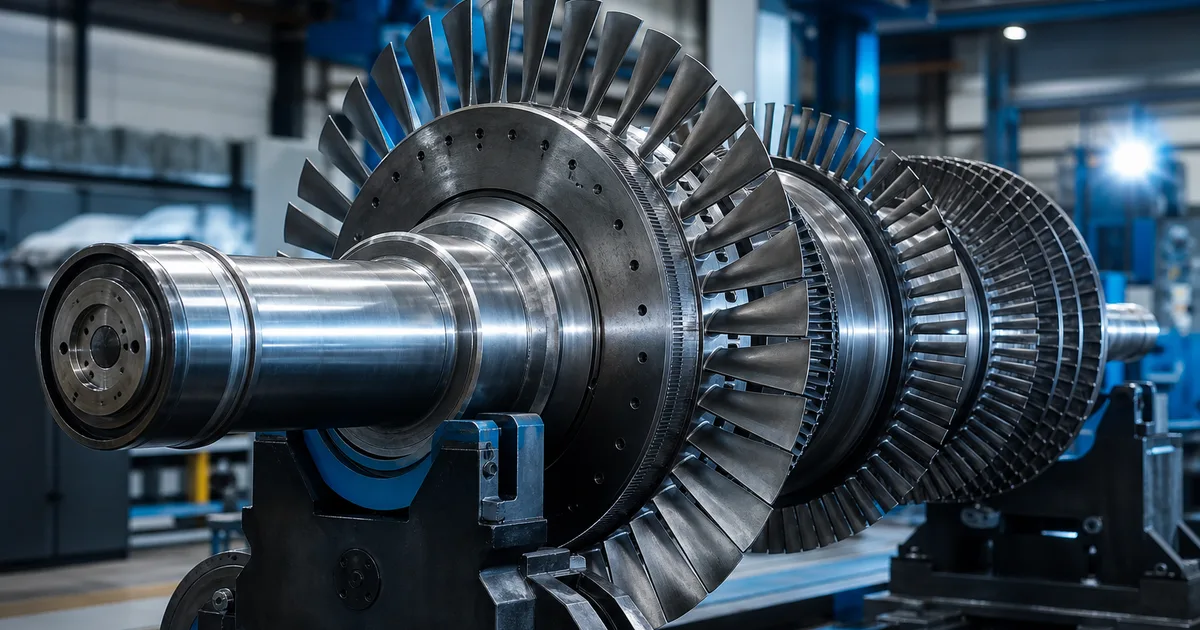
Rotor design options
The design is chosen by steam parameters, rotation speed and static-strength requirements (OST 108.020.109-82)
Monoblock forged rotor
Discs and shaft from a single forging. High rigidity and compactness, used in HP/IP cylinder rotors at high steam parameters.
- Maximum rigidity
- High steam parameters
- HP / IP
Welded rotor
Assembled from separate ring forgings and end shafts with circumferential welds. Reduces mass and disc-centre stresses — mostly used in LP rotors.
- Mass reduction
- Stress optimisation
- LP
Rotor with shrunk-on discs
Discs shrunk onto the shaft with interference. A manufacturable solution for moderate steam parameters; allows replacement of individual discs.
- Moderate parameters
- Repairability
- Built-up design
Defects, diagnostics and scope of restoration
The scope of work is defined by incoming inspection. Below is a typical "defect → NDT method → repair technology" chain
| Typical rotor defect | NDT methods | Repair / restoration technology |
|---|---|---|
| Wear, scoring, ovality of bearing journals | Visual & measuring inspection, micrometry, radial run-out and taper measurement | Electroslag or laser cladding, HVOF spraying followed by machining and re-grinding to nominal |
| Residual shaft deflection (bend) | Radial run-out measurement at control sections per factory record card | Thermal, thermomechanical or mechanical shaft straightening |
| Cracks (fillets, thermal grooves, keyways, bore) | UT, magnetic-particle (MT), eddy-current and penetrant (PT) testing | Machining out surface cracks, welding of deep defects — only if allowed by strength and residual-life assessment |
| Wear and erosion of rotating blades and discs | Visual inspection, penetrant (PT) and magnetic-particle testing of blades | Restoration or full re-blading, moment weighing |
| Damage to sealing strips | Visual inspection, clearance micrometry | Replacement of sealing rings, mechanical restoration of strip geometry |
| Creep and metal structure degradation | Hardness measurement, metallographic micro-damage analysis | For critical structure changes — rejection and manufacture of a new rotor |
The feasibility of shaft straightening and crack welding is defined by strength calculation and residual-life assessment. Not every defect is repairable — for critical metal creep the rotor is rejected.
Input data and forging requirements
A set of input data is needed to calculate the quotation and start the work. The more complete the package, the more accurate the assessment of repairability, lead time and price.
- Nameplate data: turbine type and model, manufacturer, serial number, commissioning year
- Technical documentation: rotor drawings, factory record card
- Operating conditions: total operating hours, number of starts, steam parameters, rotation speed
- Defect list: description of damage (vibration, scoring, cracks)
- Actual measurements: radial run-out (deflection), journal taper/ovality, UT/MT results, hardness
- Repair history: cladding, straightening, blade replacements
- Photos of damaged parts
Materials and standards
Shaft and monoblock rotor blanks are made of heat-resistant pearlitic steels: 25Kh1M1FA (R2, R2MA) — rotor metal temperature limit up to about 530 °C, 20Kh3MVF (EI415) — up to roughly 545 °C. The exact grade and regime are clarified per the unit documentation and questionnaire.
GOST 8479-70 Forgings of structural carbon and alloy steel. General specifications — forging groups and strength categories for shaft/rotor blanks up to 800 mm dia.
GOST ISO 1940-1-2007 Quality requirements for balancing of rigid rotors. Balancing accuracy grades (G). Introduced in place of GOST 22061-76
GOST R ISO 20816-1-2021 Vibration measurement and assessment of machine condition. Replaced the GOST ISO 10816 series
OST 108.020.109-82 Stationary steam turbines. Static-strength calculation of discs and rotors (monoblock, welded, with shrunk-on discs)
Technology, balancing, tests, lead time
Work sequence for a steam turbine rotor repair
- 1Incoming inspection
Full non-destructive testing (VT, UT, MT, PT, eddy-current), run-out and hardness measurement, metallography.
- 2Journal restoration
Electroslag or laser cladding, HVOF spraying followed by machining and grinding to nominal.
- 3Straightening & blading
Thermomechanical straightening, re-blading, seal repair and geometry restoration.
- 4Balancing & testing
Final dynamic balancing on a spin stand (G grades, GOST ISO 1940-1-2007), vibration control per GOST R ISO 20816-1-2021, overspeed tests per documentation.
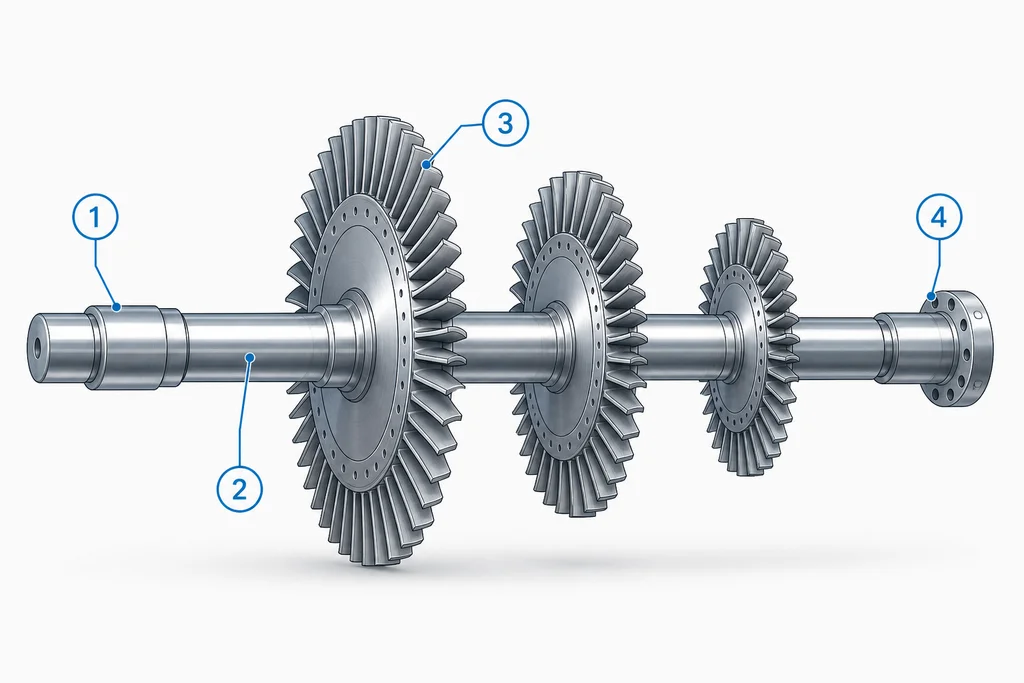
- 1 Bearing journal
- 2 Rotor shaft
- 3 Bladed disc (rotating stage)
- 4 Coupling end (generator connection)
Lead time and price for repair or manufacturing are clarified via the questionnaire — they depend on defect severity, forging availability and production load.
Technical parameters and services
| Turbine type | R, P, T, PT, K — stationary and drive |
|---|---|
| Rotor design | Monoblock / welded / with shrunk-on discs |
| Rotor steel grades | 25Kh1M1FA (R2, R2MA), 20Kh3MVF (EI415) and equivalents per documentation |
| Metal temperature limit | ≈530 °C (25Kh1M1FA) / ≈545 °C (20Kh3MVF) |
| Forging requirements | GOST 8479-70 (groups, strength categories) |
| Balancing quality | G grades per GOST ISO 1940-1-2007 |
| Scope of work | Repair / restoration / manufacture of a new rotor |
| Lead time and price | Clarified via questionnaire after inspection |
Cases
RUSTRADE experience in supplying and supporting power projects is confirmed by completed facilities
See also
Send your defect list
Send the turbine data and defect list — we will prepare a preliminary quotation for rotor repair or manufacturing within 1–2 days.
Ответы на вопросы
Мы собрали ответы на самые популярные вопросы наших клиентов. Если вы не нашли ответ на свой вопрос — свяжитесь с нами.

The decision is made after inspection. Send the turbine data (type, model, serial number), the defect list and actual measurements — we assess repairability and propose the best option: journal build-up and re-machining, blade replacement, shaft straightening or manufacturing of a new rotor. The feasibility of crack welding and straightening is defined by strength calculation and residual-life assessment, so not every defect is repairable.
Minimum for a preliminary quotation: turbine type and model, serial number, rotation speed, steam parameters (pressure and temperature), total operating hours and number of starts, defect list and photos of damaged parts. For a precise calculation we need rotor drawings (if available), the factory record card and actual measurements — radial run-out (deflection), journal ovality/taper, UT/MT results and hardness readings.
Monoblock forged shafts and rotors of steam turbines are made of heat-resistant pearlitic steels — e.g. 25Kh1M1FA (R2, R2MA) with a rotor metal temperature limit of about 530 °C, and 20Kh3MVF (EI415) up to roughly 545 °C. The exact grade and allowable regime are defined by the unit documentation and clarified via the questionnaire. General forging requirements are set by GOST 8479-70.
Three main designs: monoblock forged (high rigidity, for HP/IP cylinders and high steam parameters), welded from ring forgings (mass reduction and stress optimisation, mostly LP), and with shrunk-on discs (for moderate steam parameters). The choice is limited by steam parameters, rotation speed, available forging size and static-strength requirements per OST 108.020.109-82.
Yes. Per industry practice, after any work that changes the mass distribution (journal build-up and machining, re-blading, disc replacement, straightening) a final dynamic balancing is performed on a balancing (spin) stand. Quality-of-balancing requirements and G accuracy grades are set by GOST ISO 1940-1-2007; vibration assessment follows GOST R ISO 20816-1-2021. The overspeed test programme is agreed per documentation.
RUSTRADE experience in supplying and supporting power projects is confirmed by completed cases at TGK, sugar, chemical and oil-refining facilities. Project details and equipment parameters are available in the Cases section.
Get a Consultation
Our specialists will help you find the optimal solution for your enterprise and calculate the economic effect
All Questions & Answers
Answers to frequently asked questions about turbogenerator units, delivery times and cooperation terms
Go to FAQ
Quotation in 1–2 days
